
Reviewed · SELF-GUIDED TOURS
The Virtual Solar System Highlights: A Self-Guided Driving Tour
The most striking part of this drive is its use of giant three-dimensional planet billboards to show the true spacing of our solar system. You leave Coonabarabran and watch the planets appear along the road, turning an ordinary country drive into a simple lesson in distance and scale. I like that the tour makes a huge subject easy to grasp, and that astronomer Fred Watson adds a strong voice to the commentary.
I also like the freedom of the self-guided format. You can finish in about an hour, pause at a planet, or use the tour again later because access is unlimited. The main drawback is the app and route finding. One direction to Saturn was unclear, and some users found the GPS line and phone settings tricky, so check the map before setting off and do not rely on the spoken instructions alone.
In This Review
- Key points to know before you set off
- Why this drive works so well near Coonabarabran
- Starting at the Coonabarabran Visitors Centre
- Finding Saturn and the first route choice
- The planet billboards and what you actually do at each stop
- Listening to Marnie Ogg and Fred Watson
- Reaching Siding Spring Observatory
- App setup and route management
- Price, timing, and group value
- Who will get the most from this activity
- Should you book the Virtual Solar System Drive?
- FAQ
- Where does the tour start?
- Where does the tour end?
- How long does the drive take?
- How many planet models can I see?
- Who provides the audio commentary?
- Does the tour work without mobile service?
- Is entry to Siding Spring Observatory included?
- What is included in the $6.99 price?
Key points to know before you set off
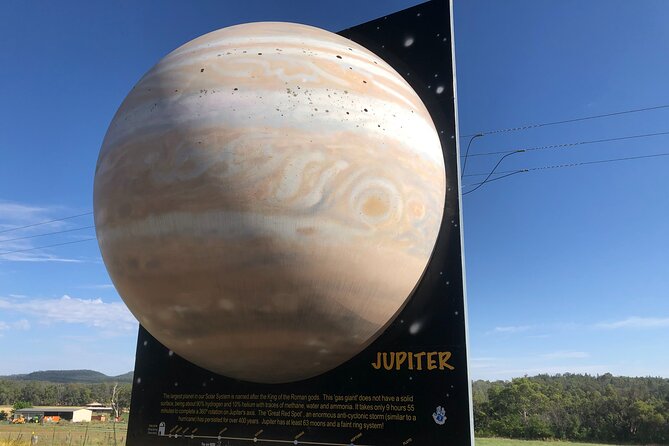
- Six of nine planet models: The drive gives you the chance to see six giant models in the Virtual Solar System display, although finding every one requires care.
- A practical astronomy lesson: The billboards help you understand the enormous gaps between planets better than a small diagram can.
- Two voices in the car: Producer Marnie Ogg leads the tour, with special guest Fred Watson, who spent 20 years as astronomer-in-charge of Australia’s biggest telescope.
- Start in Coonabarabran: The audio begins outside the Coonabarabran Visitors Centre and finishes at Siding Spring Observatory.
- Offline GPS playback: Download the audio, map, and location data through VoiceMap before you leave phone service.
- Good value for a group: At $6.99 for up to 15 people, the price is modest if several people share one car.
Why this drive works so well near Coonabarabran

Coonabarabran is known as Australia’s Astronomy Capital, and this tour gives that title a physical shape. Instead of asking you to picture the solar system from a museum panel, it places planet models along a real road between town and Siding Spring Observatory.
That matters because the solar system is hard to picture at ordinary scale. A classroom diagram puts the planets close together. On this drive, the gaps become part of the experience. You keep moving through the New South Wales countryside, waiting for the next planet to appear, and the distance itself becomes the lesson.
The billboards are colourful and made to be spotted from the road. They also give you a natural reason to stop, get out, read the information, and take a photograph. A child who might lose interest in a standard audio talk has something concrete to search for. The tour can turn a long drive into a small family mission: find the next planet, compare its size, and listen to what it means.
The experience is not a guided bus trip or a formal observatory program. You drive your own vehicle, carry your own phone, and decide how long to stay at each location. That makes it easy to fit around a wider visit to Coonabarabran, but it also means you must pay attention to the road and manage the technology yourself.
More self-guided routes around New South Wales:
- Self Guided E Bike Tour – Unicorn Falls, Rainforest & Rail Trail
★ 5.0 · 12 reviews - Self Guided Electric Bicycle Tour of Bundanoon
★ 5.0 · 7 reviews - Scavenger Hunt – Explore Newtown In A Series Of Fun Cryptic Clues
★ 4.5 · 3 reviews
Starting at the Coonabarabran Visitors Centre
The tour starts outside the Coonabarabran Visitors Centre on the Newell Highway. This is where you orient yourself, open the VoiceMap app, and hear the introduction explaining how the virtual drive works.
The booking instructions provide a unique code. After installing VoiceMap on an Android or iOS phone, enter that code and use the app to reach the starting point. Once you are in the correct place, tap start. The app then uses GPS to trigger the audio as you move.
I would take a few minutes here before driving. Confirm that the tour has loaded, check the route on the map, and make sure the audio can be heard through your phone or headphones. The app includes offline access to the audio, map, and geodata, which is useful for a country drive where mobile service may not always be dependable.
The introduction comes from producer Marnie Ogg, director of Dark Sky Traveller. Special guest Fred Watson brings an astronomy perspective shaped by his 20 years as astronomer-in-charge of Australia’s biggest telescope. That pairing gives the commentary both a clear travel purpose and a direct link to serious sky watching.
Finding Saturn and the first route choice
Saturn is one of the important early points to handle carefully. The directions toward the first stop were not clear enough for one person, who continued toward Narrabri for about 45 kilometres before turning around. The issue was not simply the distance. The instruction needed to make clear that you should stop at Saturn and then turn back toward Coonabarabran.
That is a useful warning for anyone booking a driving tour. Look at the full route before moving, especially when the next stop is not obvious. Keep the map visible for a quick check when safely stopped, and do not assume that following a spoken instruction without looking around will always work.
The route can feel confusing because the planets are placed at very different intervals. The wide spaces are part of the science, but they also mean you need to stay alert for the billboards. The models are generally easy to spot, yet you should not expect a tightly packed sequence of roadside attractions.
This is also where the tour’s central idea becomes clear. You are not rushing from one attraction to the next. You are measuring the solar system through the length of a drive. A short pause at each model may be enough, but the open spacing rewards patience.
The planet billboards and what you actually do at each stop
The display contains nine three-dimensional planet models, and this drive gives you the chance to see six of them. The models are set on large roadside billboards, with information designed to help you connect the image to the audio.
At each stop, you can pull over where appropriate, look at the model, read the panel, and listen to the related commentary. You might also take a selfie with the planet. The activity is simple, but that simplicity is its strength. There is no complicated exhibit to navigate and no fixed presentation time to catch.
The exact feel of each stop changes according to the planet and the distance from the previous one. Some points may arrive quickly, while others make you wait through a longer stretch of road. That waiting gives you a better sense of scale, though it can feel like dead time if you expected a continuous sightseeing route.
Do not assume you will automatically see every model. One person missed Uranus, and another did not reach all the planets. Watch for the signs, listen for the GPS prompt, and keep the route map in mind. If your group is eager to see all six, allow extra time rather than trying to force the experience into one rushed hour.
The models also work well for younger children. The task of looking for planets gives them something active to do, and the changing roadside setting keeps the subject from feeling like a lecture. Adults who already know basic astronomy may appreciate the scale exercise more than the introductory facts.
A few more New South Wales half-days to weigh up
- Self Guide E Bike Tour – Husk Distillery, Rainforest & Rail Trail
★ 5.0 · 17 reviews - Honey Farm Tour. Morning Tea. Guided Tasting
★ 5.0 · 3 reviews - Sydney: Opera House Guided Tour with Entrance Ticket
★ 4.8 · 8,312 reviews - Sydney Opera House Official Guided Walking Tour
★ 4.5 · 3,770 reviews
Listening to Marnie Ogg and Fred Watson
The audio is not just a list of directions. Marnie Ogg introduces the drive and explains the idea behind the Virtual Solar System. Fred Watson adds commentary from the viewpoint of someone closely connected with Australian astronomy.
That combination is important because the subject can easily become too technical or too vague. The tour needs to explain enough science to make the planet models meaningful, while still working for a family sitting in a car. The commentary is described as interesting, and its best use is to connect what you see on the billboard with the larger idea of planetary distance.
You control the pace. If the next model is visible but your group wants more time, stop and listen. If everyone has had enough, continue to Siding Spring Observatory. The audio does not force you into a set departure time or a group schedule.
The tour is in English, with lifetime access. That means you can use it before or after the date selected for booking, and you can also use the virtual tour option from home. This adds value for someone who wants to preview the route, revisit the subject later, or share the activity with a group that is not travelling together.
Reaching Siding Spring Observatory

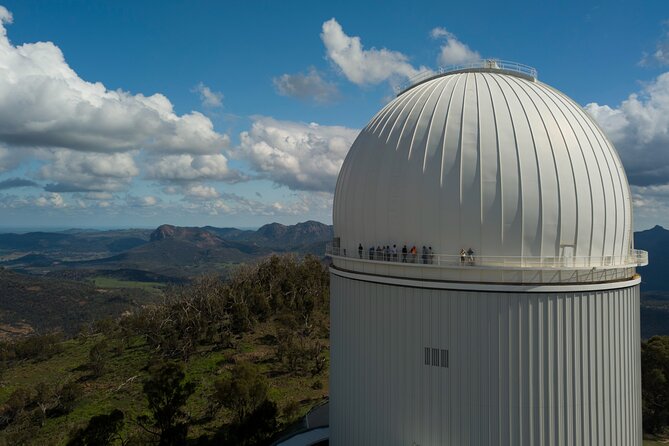
The drive ends at Siding Spring Observatory on Observatory Road. The endpoint gives the route a clear purpose: you finish at one of the key astronomy sites in the region rather than simply circling back to town.
The solar system drive itself does not include entry to museums or other attractions along the way. It also does not include a separate tour around the observatory. If you want an audio experience inside Siding Spring Observatory, there is another tour available for purchase.
That distinction matters when planning your day. This product takes you to the observatory, but it is not a full observatory admission package. You should treat the driving tour and any observatory visit as separate parts of your plans.
The published operating dates cover April 11, 2021 through February 16, 2027, with hours listed from midnight to midnight every day. Since the tour is app-based and self-guided, you are not tied to a staff member’s departure time. Still, check your wider plans for the observatory and any other attraction before setting out.
App setup and route management

VoiceMap provides automatic GPS playback and turn-by-turn directions, and it works offline after the relevant material is downloaded. That is a strong feature for this setting. You do not want the commentary to stop every time the phone loses a signal.
The weak point is ease of use. One person had to go several layers into the phone settings to make the app work, without knowing that this was required. Another followed the red route line but still received a message saying they were lost.
I would prepare before reaching the start:
- Install VoiceMap on Android or iOS.
- Enter the unique code from your booking instructions.
- Download the audio, map, and geodata.
- Open the route and inspect the direction of travel.
- Bring a charged smartphone and headphones, or use the car’s audio system if compatible.
- Check the first stop, especially Saturn, before pulling away.
If the app gives trouble, VoiceMap offers support by phone and email. It is best to contact support while the issue is happening, rather than waiting until the end and trying to reconstruct what went wrong.
The phone is not included, and neither are headphones. Food and drink are also your responsibility. Transportation is not included because you are expected to drive your own vehicle.
Price, timing, and group value
The price is $6.99 per group, with up to 15 people covered by one booking. That is excellent value for a family or group travelling in one car. Even if you use it only once, the cost is low compared with a staffed attraction.
The value becomes stronger because access is unlimited and lifetime access is included. You can use the tour before or after your booking date, and the virtual option lets you listen from home. If you visit Coonabarabran again, you do not need to buy it a second time.
The suggested duration is one to two hours. You can complete the drive in about an hour if you keep moving, but I would allow closer to two hours if you plan to stop, read the planet panels, take photos, or deal with a missed turn.
This is a private activity for your own group. There is no shared vehicle, no fixed departure, and no need to match another group’s pace. The tradeoff is that you do not have a person beside you to point out a missed billboard or correct a wrong turn immediately.
The booking is non-refundable and cannot be changed for any reason. Since the cost is small, the financial risk is limited, but you should still confirm that your route includes Coonabarabran and Siding Spring Observatory before paying.
Who will get the most from this activity
I would recommend this drive to families with children, couples interested in astronomy, and anyone passing through Coonabarabran who wants a focused activity without committing to a full day.
It is especially good for people who learn by seeing. The roadside planet models turn abstract distances into something you can experience in stages. The drive also suits independent visitors who dislike fixed tours and want to pause for photos or move on quickly.
You may enjoy it less if you want a polished, hands-off excursion. You must drive, watch for the signs, operate the app, and decide where to stop. Someone looking for a long interpretive visit inside the observatory should also know that this product ends at the observatory and does not include its separate audio tour.
Most people can participate, and the activity is private to your group. No special level of astronomy knowledge is needed. The main requirements are a vehicle, a smartphone, and enough attention to manage both the road and the route.
Should you book the Virtual Solar System Drive?
Book it if you are already driving between Coonabarabran and Siding Spring Observatory, especially with children or a group sharing one car. The planet models, Fred Watson’s commentary, and the chance to see the scale of the solar system make a short drive more memorable.
Skip it if your schedule leaves no room for route checking or roadside stops, or if app problems would spoil the day for you. The tour is affordable and flexible, but it is not foolproof. Prepare the VoiceMap app offline, study the route, and keep an eye out for Saturn, Uranus, and the other models.
For the right visitor, this is a smart little add-on to a Coonabarabran astronomy visit. It asks very little money, gives you control of the clock, and turns the road itself into the exhibit.
FAQ
Where does the tour start?
It starts outside the Coonabarabran Visitors Centre on the Newell Highway, Coonabarabran, New South Wales.
Where does the tour end?
The tour ends at Siding Spring Observatory on Observatory Road, Coonabarabran.
How long does the drive take?
The approximate duration is one to two hours. You can complete it in about an hour or spend longer at the stops.
How many planet models can I see?
The Virtual Solar System Drive has nine three-dimensional planet models, and this tour gives you the chance to see six of them.
Who provides the audio commentary?
Producer Marnie Ogg, director of Dark Sky Traveller, provides the tour, with special guest Fred Watson, who was astronomer-in-charge of Australia’s biggest telescope for 20 years.
Does the tour work without mobile service?
Yes. VoiceMap provides offline access to the audio, maps, and geodata after they have been downloaded.
Is entry to Siding Spring Observatory included?
No. The driving tour ends at Siding Spring Observatory, but tickets or entrance fees for museums and other attractions are not included. A separate audio tour around the observatory can be purchased.
What is included in the $6.99 price?
The price covers one group of up to 15 people, lifetime access to the English tour, the VoiceMap app for Android and iOS, and offline access to the audio, maps, and geodata. A smartphone, headphones, food, drink, and transportation are not included.
Just added around New South Wales
- Uncover the Magic Gin Distillery Adventure at Millsheds Bowral★ 4.5 · 3 reviews
- Honey Farm Tour. Morning Tea. Guided Tasting★ 5.0 · 3 reviews
- Tour from Eden to Merimbula Wetlands Wildlife and Coastline★ 5.0 · 3 reviews
- From Sydney Blue Mountains Private Tour with Wildlife Park★ 3.5 · 3 reviews
- Port Macquarie Day Tour to Water Falls and Lookouts★ 5.0 · 3 reviews
- Private Surf Coaching Session in New South Wales★ 5.0 · 3 reviews
- Sparkling Masterclass with Vineyard Tour and 4 Course Lunch★ 5.0 · 3 reviews
- Southern Highlands Full-Day Wine Tour★ 5.0 · 3 reviews
Self-Guided Tours, compared.


E-bike (electric) – Blue Mountains – Hanging Rock – SELF-GUIDED Hire Service
Read our review →
Electric Bike Rental & Wheel Explorer Audio Guide
Read our review →
Self Guided E Bike Tour – Unicorn Falls, Rainforest & Rail Trail
Read our review →
Self-Guided Sydney Middle Harbour Kayak 3 Hour Tour by Double Kayak
Read our review →
Sydney Ghost Quest: Self-Guided Haunted History Game
Read our review →
Browse the lists this tour appears in